0
0
Getting a new aircon installed in Singapore is not complicated, but there is a lot that can go wrong if you choose the wrong contractor or go into the process without knowing what to expect. Prices between contractors vary by thousands of dollars for the same job. In HDB flats, the rules around installation are strict, and missing the 14-day reporting deadline has real consequences. And a poor installation can affect how the unit performs for the next 8 to 12 years.
This guide covers everything: full 2026 installation costs by system type, what is included and what is not, how to size your system correctly for each room, the HDB and condo compliance rules, the current refrigerant situation, brand comparisons and how to check the work before you pay. Whether you are fitting a new home, replacing an ageing system or upgrading, the information below applies.
Installation costs depend on the number of indoor units, the piping run required, and whether additional electrical or concealment work is needed. The figures below are for labour and standard materials. The aircon units themselves are purchased separately.
|
System Type |
Labour Only (SGD) |
Unit + Install Approx. (SGD) |
Best Suited For |
|
System 1 (1 indoor + 1 outdoor) |
$850 to $1,650 |
$1,550 to $3,100 |
Single room, studio, small flat |
|
System 2 (2 indoor + 1 outdoor) |
$1,450 to $2,800 |
$2,800 to $5,200 |
2 to 3-room HDB, 1-bedroom condo |
|
System 3 (3 indoor + 1 outdoor) |
$2,200 to $3,800 |
$3,900 to $7,000 |
3 to 4-room HDB, 2-bedroom condo |
|
System 4 (4 indoor + 1 outdoor) |
$2,800 to $4,500 |
$5,000 to $9,000 |
5-room HDB, 3-bedroom condo, terrace |
|
System 5 (5 indoor + 1 outdoor) |
$4,300 to $6,500+ |
$7,000 to $12,000+ |
Landed, large condo, commercial |
|
Straight swap (reuse existing piping) |
$700 to $1,000 |
Unit cost + $700 |
Replacing a unit, no rerouting needed |
Most Singapore aircon installation quotes include the following as standard:
Items typically charged separately:
For an itemised written quote with no day-of surprises, contact Cool Channels Engineering for a free site assessment.
The most common installation mistake in Singapore is fitting the wrong capacity unit in a room. An undersized unit runs continuously and still cannot cool the space. An oversized unit short-cycles, which means it switches on and off too frequently, uses more electricity and wears out the compressor faster. Capacity is measured in BTU per hour or in horsepower.
|
Room Size (sq ft) |
Recommended BTU/h |
HP Rating |
Typical Singapore Room |
|
Up to 150 |
7,000 to 9,000 |
0.75 to 1.0 HP |
Small bedroom, study, helper’s room |
|
150 to 250 |
9,000 to 12,000 |
1.0 to 1.5 HP |
Standard HDB bedroom, small living room |
|
250 to 400 |
12,000 to 18,000 |
1.5 to 2.0 HP |
Master bedroom, mid-size living room |
|
400 to 600 |
18,000 to 24,000 |
2.0 to 2.5 HP |
Open-plan living area, large condo living room |
|
600 and above |
24,000 and above |
2.5 HP and above |
Large open-plan, commercial space |
Room dimensions are a starting point. A bedroom on a high floor facing west with full afternoon sun will need a stronger unit than a shaded ground-floor room of the same size. Rooms with many occupants or heat-generating equipment, such as a home office or cooking area, also need more capacity. When in doubt, size one step up rather than down.
Singapore’s NEA Mandatory Energy Labelling Scheme rates residential aircon units from 1 to 5 ticks. A 5-tick unit uses 20 to 35 percent less electricity than a 1-tick unit of the same capacity. At Singapore’s electricity tariffs, the difference in running cost recovers the higher upfront price within 2 to 3 years of daily use.
Knowing what a proper installation looks like helps you judge whether the job is being done correctly.
Before installation day, a reputable contractor should carry out a site survey. This means measuring pipe runs from each indoor location to the outdoor unit position, checking available space on the electrical distribution board, confirming drainage routing, and noting whether custom brackets are needed for the outdoor unit. Contractors who quote remotely without a site visit will almost always add charges on the day.
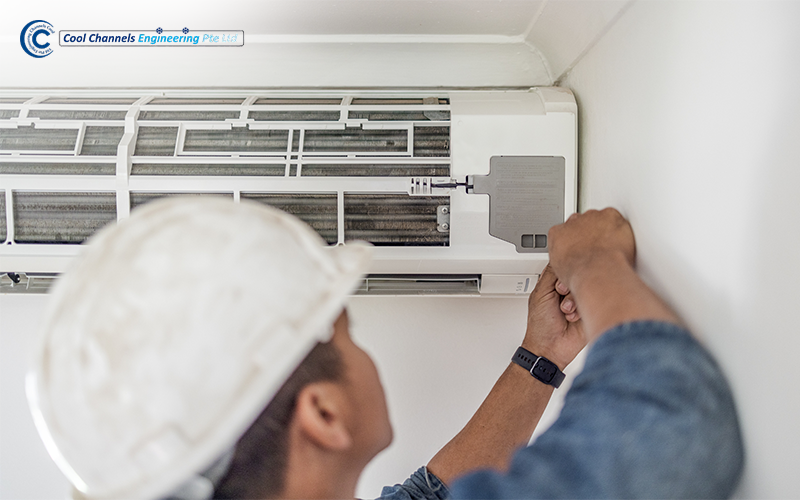
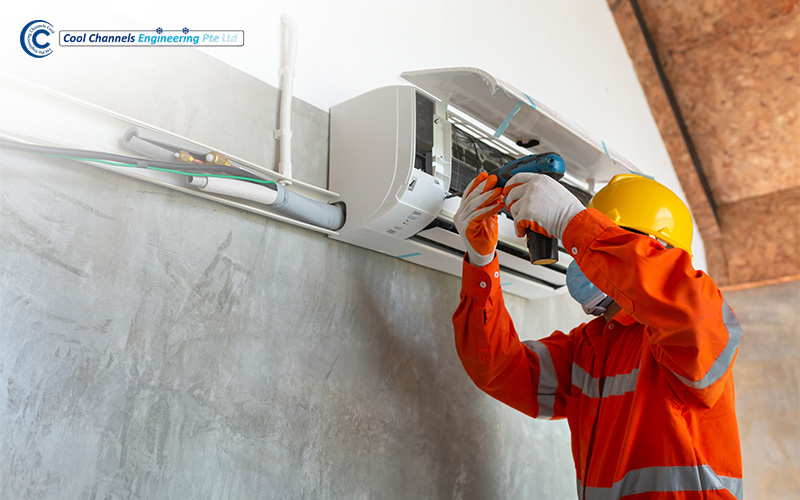
Cool Channels technician mounting an aircon indoor fan coil unit on a wall bracket during installation in Singapore
The indoor fan coil unit is fixed to a wall bracket at a height that allows good airflow across the room without blowing air directly onto sleeping occupants or sensitive electronics. The standard position in most Singapore HDB bedrooms is above the window or door frame, at least 15 to 20 centimetres below the ceiling. The technician confirms the unit is level before securing it.
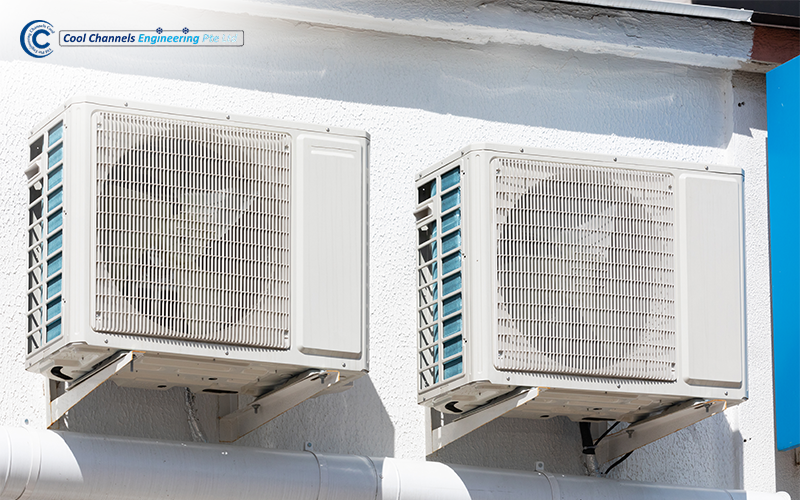
Aircon outdoor condensing unit installed on designated HDB aircon ledge with stainless steel brackets Singapore
The outdoor condensing unit is secured on the designated HDB aircon ledge or an installed bracket. For HDB flats, the unit must go on the ledge allocated to that specific flat only. Common corridor placement is not permitted. The technician confirms adequate clearance on all sides of the outdoor unit for proper airflow and that the unit is properly secured to prevent vibration.
Copper refrigerant pipes connect each indoor unit to the outdoor condenser. The drainage pipe runs from each indoor unit’s condensate tray to the nearest floor trap. A dedicated electrical circuit or isolator switch handles the power supply for each indoor unit. All three systems should be routed cleanly and secured along the trunking route before any covers are fitted.
Before switching the system on, the refrigerant circuit is pressure-tested to confirm no leaks exist in the new piping. The system is then vacuumed to remove moisture and air from inside the copper pipes before the R32 refrigerant is introduced. This step is non-negotiable. Skipping it is the most common cause of early gas leaks and below-specification cooling output.
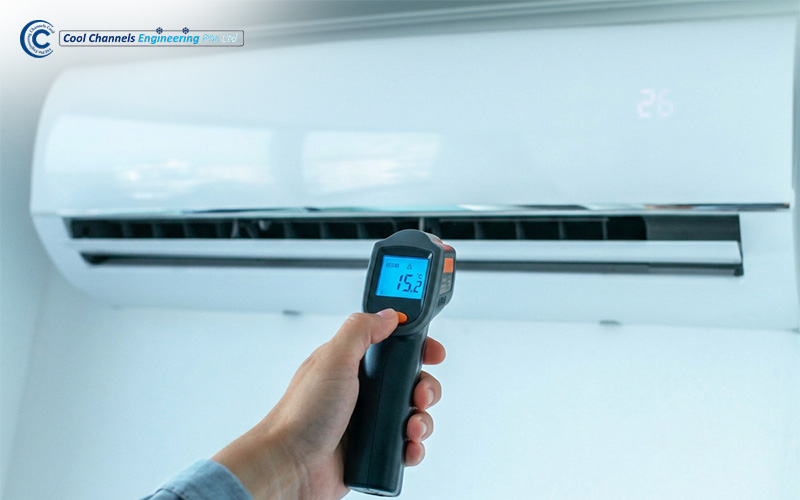
Cool Channels technician checking aircon outlet temperature with thermometer during post-installation test run in Singapore
Every unit should run for at least 30 minutes with a thermometer check before the job is signed off. The indoor air outlet temperature should read between 12 and 15 degrees Celsius when the unit is set to 22 degrees Celsius. Both units should operate without unusual noise or vibration. Do not make final payment until this test is done and the results are satisfactory.
HDB treats installation compliance seriously. Getting the process wrong means mandatory rectification at your own expense and potentially a fine.
The following rules come directly from HDB’s official aircon installation renovation guidelines:
Condo installations require written approval from the Management Corporation Strata Title (MCST) before work begins. Most condos have a standard approval form that covers the unit type, brand, proposed outdoor unit location and method of drainage. Some MCSTshave a list of approved contractors or specifications that must be met. Obtain written MCST approval before booking your installation date.
Landed property owners generally have fewer restrictions. If the outdoor unit is visible from a public road or a shared boundary, a BCA permit may be required before installation. Check with your contractor in advance.
If you are installing a new system or replacing an existing one, this is worth understanding before you buy.
|
Refrigerant |
Status in Singapore |
Gas Top-Up Cost |
What This Means for You |
|
R32 |
Current standard from 2022 |
$80 to $140 |
Better energy efficiency, lower global warming potential. All new Singapore systems use R32. Compatible gas is widely available. |
|
R410A |
Legacy (2010 to 2022) |
$120 to $180 |
Still serviceable and gas is available, but phasing out. If replacing soon, upgrade to R32. |
|
R22 |
Banned for new installations |
$150 to $220 |
Cannot be used in new systems. If your existing unit runs on R22, the full system including all copper piping must be replaced. R22 and R32 are not compatible. |
For all new residential installations in Singapore from 2022 onwards, R32 is the only compliant refrigerant. If you are replacing an old R22 system, budget for a full replacement of both units and all copper piping.
The brand you choose affects the unit price, long-term electricity costs and how easy it will be to find parts and qualified technicians in future. Here is how the main options compare in Singapore:
|
Brand |
System 3 Unit Price (approx.) |
Known For |
Notes for Singapore Buyers |
|
Daikin |
$3,500 to $5,500 |
Reliability, parts availability |
The most installed brand in Singapore. Technicians familiar with Daikin systems are available island-wide. Spare parts are easy to source. |
|
Mitsubishi Electric Starmex |
$3,800 to $5,800 |
Quiet operation |
Best option for bedrooms where noise is a concern. Strong inverter performance and energy efficiency. |
|
Mitsubishi Heavy Industries |
$2,800 to $4,500 |
Value, reliability |
Solid mid-range performance without the premium price. Popular choice for secondary rooms. |
|
Panasonic |
$2,800 to $4,800 |
Inverter efficiency |
Among the highest NEA energy tick ratings. Good for long-term running cost savings. |
|
LG DualCool |
$2,500 to $4,200 |
Smart home features |
Compatible with Google Home and Matter. Suitable for tech-focused households. |
|
Samsung WindFree |
$3,000 to $5,000 |
Comfort cooling |
WindFree mode circulates air without direct airflow. Well-suited for sleeping areas. |
|
Fujitsu |
$2,800 to $4,500 |
Humidity control |
Performs well in Singapore’s humid conditions. Less prominent brand presence but reliable. |
|
Midea |
$1,800 to $3,200 |
Entry-level pricing |
Budget option with shorter standard warranty. Suitable for lower-usage rooms. |
Cool Channels Engineering installs all brands listed above. See our aircon installation page for current availability.
The Singapore government’s Climate Friendly Households Programme provides cash vouchers that can be used to offset the cost of purchasing an energy-efficient aircon. Here are the confirmed details as of June 2026:
Check your eligibility and see the full list of participating retailers at the Climate Friendly Households Programme official website.
|
Practical tip: Check the NEA energy label before purchasing your unit. A 5-tick unit qualifies for the Climate Vouchers and uses 20 to 35 percent less electricity. At Singapore electricity rates, the energy saving alone often covers the cost difference within 2 years. |
Going through these before the team arrives prevents last-minute surprises and disputes.
This is the step most installation guides skip. Running through this before the team leaves protects you from discovering faults the following day when the contractor is no longer on-site.
If you are considering a new installation because your current system is giving problems, this table can help you decide.
|
Situation |
Recommendation |
Reason |
|
Unit under 5 years old, single fault |
Repair |
Repair cost is likely well below the unit’s remaining value |
|
Unit 5 to 8 years old, one significant fault |
Get a repair quote first |
Compare the repair cost to 50 percent of a new system price. If repair is cheaper, proceed. |
|
Compressor failed, unit over 8 years old |
Replace |
Compressor replacement on an aging unit often costs more than a new system and only extends the life by a few years |
|
Unit runs on R22 refrigerant |
Replace |
R22 gas cannot be recharged in Singapore. R22 and R32 systems are not compatible. Replacement of both units and all piping is the only long-term option. |
|
Recurring faults, unit over 10 years old |
Replace |
Repeated repair costs plus rising electricity bills from a worn compressor usually exceed the cost of a new system within 2 years |
|
Energy bills rising despite regular servicing |
Replace with 4 or 5-tick unit |
A high-efficiency replacement typically recovers its upfront cost within 2 to 3 years through electricity savings |
If you are unsure whether to repair or replace, our aircon repair team can carry out an honest assessment before any work is committed to.
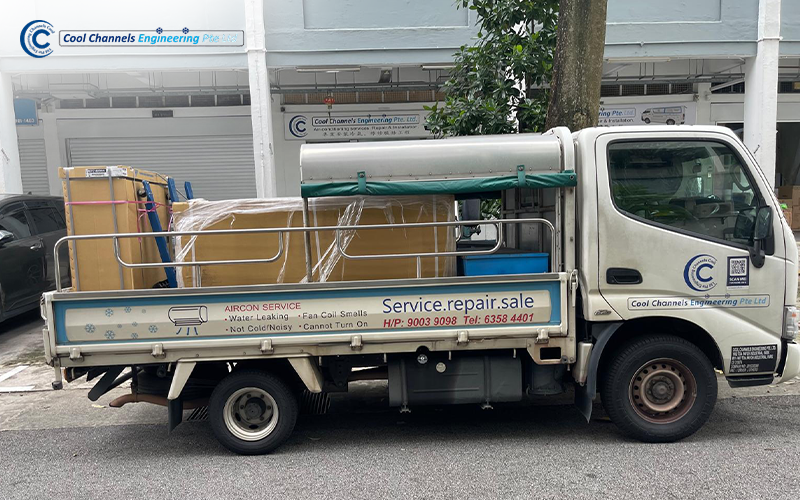
Cool Channels Engineering professional aircon installation team Singapore
Cool Channels Engineering Pte Ltd carries out aircon installation for new homes, renovations, system upgrades and direct unit replacements across all regions of Singapore. We handle System 1 through System 5 residential configurations and commercial system types including VRF, cassette and ducted. Every job includes a written itemised quote, a site survey, a full test run on completion and HDB submission handling where required.
View our aircon service page or contact us for a free site survey.
Labour-only installation ranges from approximately $850 for a System 1 to $6,500 or more for a System 5. Full packages including the aircon units range from around $1,550 to $12,000 or more depending on system size and brand. These are 2026 Singapore market figures. Contact Cool Channels for a written site-specific quote.
You do not need prior HDB approval for a standard installation on the existing designated ledge. However, the installation must be done by a BCA-trained technician, and an installation report must be submitted to your local HDB branch within 14 days of completion. Full details are at the HDB official renovation guidelines page.
A System 2 takes 3 to 5 hours including testing. A System 3 takes 4 to 6 hours. A System 4 or 5 can take a full working day, especially if concealment work or electrical upgrades are involved. Tight outdoor ledge access or longer piping runs also add time.
Possibly. If the existing piping is under 8 years old, has no visible corrosion and has no prior leak history, a 30-minute vacuum test can confirm whether it is serviceable. If the pressure holds, the piping can be reused and saves $300 to $800 on a multi-system job. If the pressure drops, the piping needs to be replaced. Note that R22 piping cannot be reused for an R32 system.
Climate Vouchers from the Climate Friendly Households Programme can be used to purchase the aircon unit itself at participating retailers, provided the unit carries a 3-tick NEA energy rating or higher. The vouchers are applied at the point of purchase, not at the installation stage. Eligible households can claim up to $400 in vouchers, valid until 31 December 2027.
Cool Channels Engineering provides a 90-day workmanship warranty on all installation work. Manufacturer warranties on the units typically cover 1 year for parts and labour and 5 years for the compressor, though this varies by brand. Confirm the exact manufacturer warranty terms with your supplier at the time of purchase.
For new installations, yes. R32 has higher energy efficiency, a lower global warming potential and a lower gas top-up cost when needed. It is the required refrigerant for all new residential systems in Singapore from 2022. R410A is no longer used in new installations, though existing R410A systems remain serviceable.
A new aircon should be serviced every 3 to 4 months to maintain performance. Our annual maintenance contracts start from $120 per year and include scheduled quarterly service visits with full written records each time.
Cool Channels Engineering Pte Ltd – Professional Aircon Installation, Maintenance, Servicing and Repair | Serving Singapore Since 1999