0
0
If your aircon still smells musty, blows warm air, or leaks water after a standard service, the next step is either a chemical wash or a chemical overhaul. Both go deeper than routine servicing, but they are not the same thing and they are not interchangeable. Choosing the wrong one means either paying more than necessary or not fixing the actual problem.
This guide explains exactly what each involves, how much they cost in Singapore in 2026, and how to tell which one your unit actually needs.
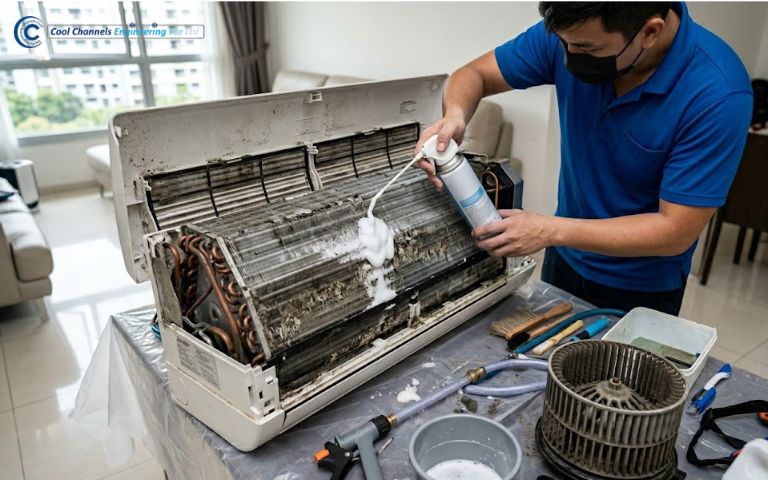
A chemical wash is a mid-level deep clean. The technician partially dismantles the indoor unit to access the evaporator coil, fan blower and drainage tray directly. A chemical cleaning solution is then applied to dissolve biofilm, mould, mineral deposits and dirt that has built up on these components over months of use.
The process takes 60 to 90 minutes per unit. It does not require full disassembly, which makes it faster and less expensive than an overhaul while still being significantly more thorough than a standard general service.
A chemical wash is the right choice when:
A chemical overhaul is the most thorough cleaning option available. The technician fully disassembles the indoor unit, removing every component including the evaporator coil, fan blower, drainage tray, housing and covers. Each piece is cleaned individually with chemical solution, inspected for damage, and reassembled.
The process takes 90 to 120 minutes per unit. It reaches areas that a wash cannot, particularly the back of the evaporator coil and enclosed drainage channels where mould and debris accumulate in heavily neglected units.
An overhaul is the right choice when:
| Criteria | 9–12 BTU Chemical Wash Overhaul | 18–24 BTU Chemical Wash Overhaul |
|---|---|---|
| What it involves | Deep cleaning of the fan coil unit using chemical treatment to remove dirt, mould and blockages. | Deep cleaning of larger-capacity fan coil units using chemical treatment to restore performance. |
| Time per unit | 60–90 minutes | 90–120 minutes |
| Cost per unit (SGD) | From $130/unit | From $160/unit |
| Best for | Residential aircon units with weak cooling, odours or water leakage. | Larger residential or commercial units requiring intensive cleaning. |
| Benefits | Improves cooling efficiency, airflow and indoor air quality. | Restores performance and prolongs equipment lifespan. |
| Recommended frequency | Every 12–18 months, depending on usage. | Every 12–18 months, depending on usage and operating environment. |
The simplest way to decide is to start with the less invasive option. If your unit has not had a chemical wash before, or if the last one was more than 12 months ago, a chemical wash is almost always the right first step. It resolves the majority of odour, airflow and mild cooling issues.
If the chemical wash does not fully resolve the problem, or if your technician notes heavy internal build-up during the wash, then an overhaul is the next step. Jumping straight to an overhaul without trying a wash first is usually unnecessary and costs more without a proportional benefit.
There is one exception: if your unit has not been serviced at all for two or more years and is showing multiple symptoms (smell, weak cooling, visible mould, water leak), an overhaul is likely more cost-effective than doing a wash first and then an overhaul anyway.
Ignoring the need for deep cleaning leads to a predictable sequence. The biofilm on the evaporator coil thickens, restricting airflow and heat transfer. The compressor works harder to compensate, drawing more electricity. The drainage channel narrows until it blocks completely, causing water to back up and leak from the indoor unit. Eventually the compressor overheats and fails, at which point the repair cost ($400 to $800 or more) or full replacement cost ($2,800 to $5,000 or more) dwarfs what a chemical wash or overhaul would have cost.
Regular maintenance prevents this cycle entirely. Our complete aircon maintenance guide for Singapore covers the full recommended schedule by usage type and property.
Cool Channels Engineering is a trusted air conditioning service and repair provider in Singapore with over 25 years of experience across residential and commercial systems. Our technicians will assess your unit on-site and recommend the right option before any work begins.
View our full chemical wash and overhaul service page for more details on what each service includes.
For bookings, WhatsApp us at +65 9003 9098 or call +65 6258 8400. Available Monday to Saturday 8:30am to 10pm, Sunday 8:30am to 5pm.
A chemical wash at Cool Channels costs from $130 to $160 per unit. Final pricing depends on the unit type, brand and condition. All prices include GST.
For most Singapore homes with daily aircon use, every 12 to 18 months is the recommended interval. Units in dusty environments or near renovation works may need it more frequently.
If the leak is caused by a blocked drainage channel, a chemical wash will likely resolve it. If the leak is caused by a cracked drain pan or a refrigerant issue, it is a repair rather than a cleaning issue. Contact our technicians for an on-site diagnosis.
Only if a chemical wash has already been attempted and the problem persists, or if the unit has been severely neglected for two or more years. In those cases, the overhaul reaches areas a wash cannot and is genuinely worth the additional cost.